In boardrooms around the world, CEOs increasingly ask whether artificial intelligence can predict luxury’s next big trend. The assumption is intuitive: feed an algorithm enough data, and it will calculate the perfect product. But this thinking misunderstands what AI actually does. AI is a probability engine, designed to extend patterns from the past. It is, by definition, a rearview mirror. Luxury, on the other hand, is fundamentally non-linear. It thrives on surprise, originality, and cultural breakthroughs elements no algorithm can predict. Had AI been asked in 1984 to imagine the ultimate status symbol, it would have generated a refined briefcase, not the disruptive icon that became the Birkin.
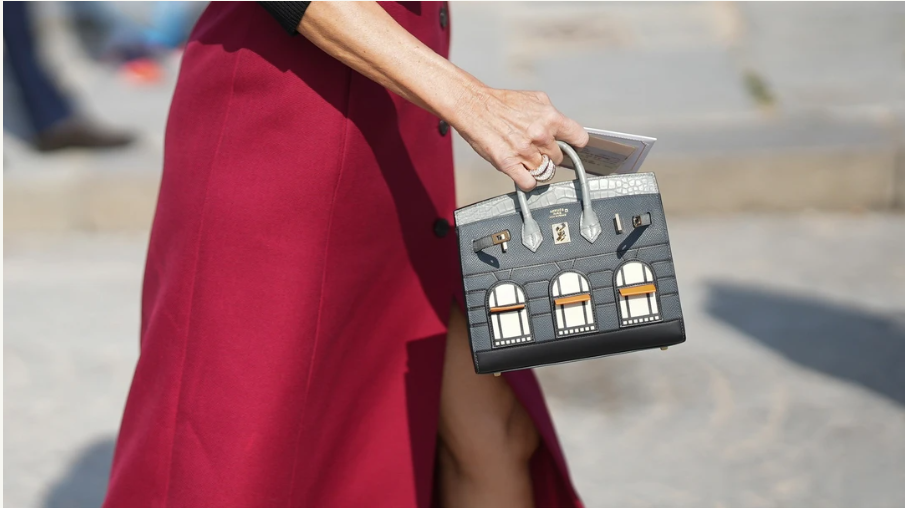
The Hermès Birkin 20 Faubourg Rainy Days is a limited-edition bag that resembles the façade of the Hermès store on Rue du Faubourg-Saint-Honoré in Paris. Image: Getty Images
The real danger for luxury brands is not ignoring AI but misusing it. When AI is tasked with creative ideation, it mathematically guides brands toward the average. Ask it to design a luxury hotel lobby and it will produce a flawless blend of existing lobbies beautiful, polished, and completely forgettable. This leads to the sameness already suffocating parts of the luxury industry. Many brands celebrate AI-generated designs because they look professional, yet these outputs lack emotional depth, cultural nuance, and the friction that creates Added Luxury Value (ALV). AI is the ideal tool for brands that want to blend in, but a fatal one for brands that need to lead.
AI is extraordinary when it comes to execution. It enhances supply chains, optimizes websites, and detects micro-shifts in behavior long before humans can. At Équité, brands are encouraged to leverage AI aggressively for these operational layers because friction is the enemy of premium experiences. But imagination operates on a different frequency. Luxury depends on seduction understanding desire, aspiration, and the emotional thrill of rarity. Algorithms do not feel. They cannot understand the irrational joy of discovering something extraordinary. When brands attempt to automate the dreaming phase, they strip away the story and soul that justify premium prices. Without a narrative, there is no perceivable value.
As AI becomes universal, raw intelligence loses its competitive advantage. Anyone can access world-class models with a subscription. As a result, the true premium in luxury is shifting from IQ to EQ. The future leaders of luxury will be those who use AI to eliminate the mundane, allowing human talent to focus on creativity, cultural interpretation, and emotional connection. Luxury managers were once administrators of excellence. Now they must become curators of emotion. Imagination, intuition, and cultural sensitivity are becoming the new strategic superpowers.
A Mandate for Luxury Leaders: Protect the Creative Soul
For CEOs and creative directors, the mandate is unmistakable. AI should never be used to define a brand’s soul. It should audit efficiency but not dictate imagination. The next Birkin, the next iPhone, or the next transformative hospitality concept will not emerge from a prompt or a dataset. It will be created by a human who sees what the data cannot who senses emerging cultural energy and dares to dream beyond probability. AI can predict the probable, but luxury is about making the impossible real. The brands that will define the future are those that protect human imagination as their rarest asset.
https://www.equiteintelligence.com
This is an opinion piece by Daniel Langer, CEO of Équité, recognized as one of the “Global Top Five Luxury Key Opinion Leaders,” and advisor to some of the most iconic luxury brands in the world. He serves as an executive professor of luxury strategy and pricing at Pepperdine University in Malibu and as a professor of luxury at NYU, New York. Daniel has authored best-selling books on luxury management in English and Chinese, and is a respected global keynote speaker.
Daniel conducts in-person masterclasses on various luxury topics across the world. As a luxury expert featured on Bloomberg TV, Forbes, The Economist, and others; Daniel holds an MBA and a Ph.D. in luxury management, and has received education from Harvard Business School.
